


Lumpectomy


What is a lumpectomy?
A lumpectomy is a surgical procedure used to remove a portion of tissue from the breast. In a lumpectomy, a surgeon will remove cancerous tumors along with a small portion of healthy surrounding tissue from the breast, but not the entire breast itself. A lumpectomy is considered breast-conserving surgery because it spares, or conserves, most of the breast.
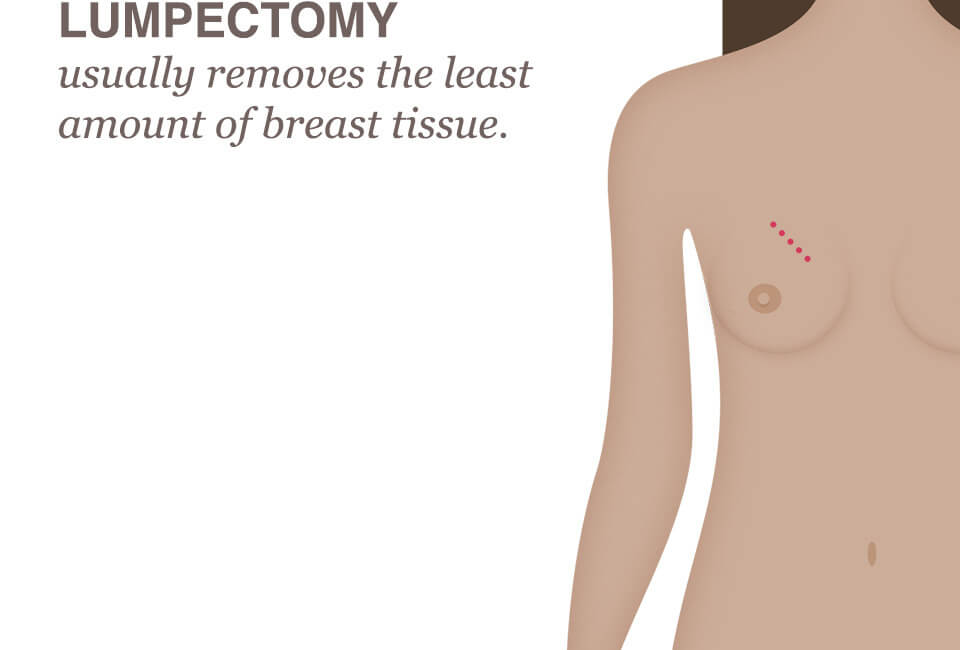
Even though a lumpectomy is the least invasive breast cancer surgery, it can still be a very effective treatment option for certain breast cancers.
When is a lumpectomy used?
A lumpectomy is a treatment option for early-stage breast cancer when the cancerous tumor is small. If a patient’s tumor is large, chemotherapy may be given first to shrink the tumor (called neoadjuvant chemotherapy), making a lumpectomy a viable surgical option.
A lumpectomy is most often used when there is a single tumor to be removed, or multiple small tumors that are close enough together to be removed at once.
A lumpectomy may also be used in benign conditions to remove non-cancerous breast lumps or to treat conditions that may increase the risk of breast cancer, such as LCIS. In such cases, the doctor may refer to this surgery as a breast biopsy or surgical breast procedure, preserving the term “lumpectomy” to be only associated with malignant surgeries of the breast.
What happens when more tissue needs to be taken?
If more tissue needs to be taken from the affected area of the breast, a surgeon may perform a partial mastectomy rather than a lumpectomy. This procedure requires the surgeon to remove a larger portion of the breast than in a lumpectomy, such as a whole segment or quadrant of tissue, in order to eliminate the cancer. Occasionally, the surgeon will remove some of the lining over the chest muscles as part of a partial mastectomy as well.
Free Breast Cancer Surgery eBook
Download the free Breast Cancer Surgery eBook to learn about the different types of breast cancer surgeries, including lumpectomy, and when each type may be used.
Get the Free eBookJump to
What is a lumpectomy?
Lumpectomy vs. mastectomy
Lumpectomy types
Sentinel lymph node biopsy with lumpectomy
What to expect for a lumpectomy
Breast reconstruction after lumpectomy
Lumpectomy FAQs
Lumpectomy vs. mastectomy
Both lumpectomy and mastectomy are surgical procedures used to treat breast cancer. While a lumpectomy removes only a portion of the breast tissue, conserving most of the breast, a mastectomy removes the entire breast and all breast tissue.
The type of surgery needed will depend on the type and stage of breast cancer you have, and any other treatment you may need. The following chart illustrates when a lumpectomy may be recommended versus a mastectomy.
Factor | Lumpectomy | Mastectomy |
Tumor size | Tumor is small relative to breast size | Tumor is large relative to breast size |
Number of tumors | Single tumor, or multiple small tumors clustered close together | Multiple tumors in different locations in the breast |
Tumor location | Can be removed with clear margins while preserving the breast shape | Location makes breast conservation difficult |
Cancer stage | Early-stage breast cancer, generally Stages 0-2, some Stage 3 | Any stage, depending on other clinical and prognostic factors |
Radiation therapy | Required after lumpectomy in most cases | May or may not be required after mastectomy |
Genetic mutation (BRCA gene mutation) | Sometimes used, but less common when there is a genetic link | Prophylactic (preventive) double mastectomy often recommended to reduce future cancer risk |
Lumpectomy usually not recommended | Mastectomy usually recommended | |
Not usually recommended since the disease has already spread beyond the breast | Not usually recommended since the disease has already spread beyond the breast |
Lympectomy types
There are several different types of lumpectomies, each with its own specific use and indications.
Excisional biopsy
An excisional biopsy is a diagnostic procedure rather than a treatment for breast cancer. In this procedure, a surgeon removes a tumor as part of a biopsy. The tumor is then sent to a lab to be tested for cancer.
Wide local excision
In a wide local excision, a surgeon removes the cancerous tumor along with a small margin of healthy tissue around it. The healthy tissue will then be tested by a pathologist to make sure that there are no additional cancerous cells. If no cancerous cells are found, it means that the wide local excision successfully removed all of the cancer.
Re-excision of margins
This is a follow-up procedure to a wide local excision. If the pathology report shows cancerous cells within the margin of healthy tissue that was removed, the surgeon will reopen the surgical site and remove more tissue to ensure that all the cancer cells are gone.
Quadrantectomy
About a quarter of the breast tissue, including the tumor, a margin of healthy tissue around it, and milk ducts are removed in a quadrantectomy. Though also considered a partial mastectomy, a quadranectomy is still a type of breast-conserving surgery.
Sentinel lymph node biopsy with lumpectomy
Many people who have a lumpectomy will also have a sentinel lymph node biopsy, which is performed during the same procedure. When breast cancer spreads, it usually spreads to lymph nodes first, which is why lymph nodes may be biopsied during a lumpectomy.
In this procedure, some lymph nodes near your armpit are removed and sent to a lab to be checked for cancer. To find the sentinel lymph nodes, a blue, radioactive tracer dye will be injected into the breast. The surgeon then removes the lymph nodes that contain the blue tracer dye.
A healthcare professional will then examine the lymph nodes under a microscope to check for cancer. If cancer is found in the sentinel lymph nodes, the surgeon will likely remove more lymph nodes from the armpit to look for cancer.
What to expect for a lumpectomy
If your care team has recommended you have a lumpectomy either as a diagnostic measure or to remove cancer from the breast, it is good to know what to expect in advance.
Before the lumpectomy
Before your lumpectomy, you will need to have a localized procedure, called localization, to mark the part of the breast that needs to be removed during the lumpectomy. During localization, a radiologist will use a needle and wire to insert a small radioactive “seed” into the area to be removed. This seed will serve as a bullseye, helping the surgeon locate the area during your lumpectomy.
You will also need to follow all of your surgeon’s instructions before the lumpectomy, including dietary guidelines, washing and sanitation instructions, and medication guidelines. Your surgeon and their office staff will give you a list of instructions to follow before your procedure.
During the lumpectomy
A lumpectomy is performed under general anesthesia, meaning you will be asleep and unable to feel any pain during the procedure. A local anesthetic that causes numbness may also be used to help decrease pain in the breast.
The surgeon will begin by making an incision in your breast over the cancerous spot or the area that was marked by the radioactive seed placed during localization. The surgeon will then remove the cancer and a portion of healthy tissue around it. This tissue will be sent to the lab, where a pathologist will test it to make sure all the cancer has been removed. If the pathologist discovers that cancer cells may have been left behind, the surgeon will need to remove more breast tissue until it is all gone.
If you will be receiving radiation after the lumpectomy, the surgeon might place small metal clips at the site where the cancer was removed. These clips will ensure the radiation is delivered to the correct place in the breast.
Once the lumpectomy and clip placement are complete, the surgeon will use stitches, adhesive strips, and/or skin glue to close the incision.
After the lumpectomy
After your lumpectomy, your care team will give you detailed instructions on how to care for your incision, how to handle pain relief, and what to do if there is a complication. Your doctor will also tell you what sort of follow-up appointments or additional treatments you may need.
You may need to wear a supportive surgical bra for a while after your lumpectomy. This bra will help decrease swelling and aid in healing.
As with any surgical procedure, including lumpectomy, there is a risk of developing a post-surgical infection. Report any of the following signs of infection to your doctor immediately:
- Fever greater than 100.5°
- Shaking chills
- Increased pain, redness, or red streaks around the surgical site
- Warm skin or swelling around the incision
- Pus or other drainage from the incision
- Bleeding from the site or stitches that have come undone
- Vomiting or diarrhea that lasts for more than 4 hours
- Drowsiness, confusion, or inability to wake
Breast reconstruction after lumpectomy
Depending on how much breast tissue was removed as part of a lumpectomy, the breast tissue that is left may not appear as it did before the surgery. In order to help reshape the breast, some women choose to undergo breast reconstruction.
Breast reconstruction after lumpectomy often uses remaining tissue, breast implants, or transplanted fat or tissue from other areas of the body to reform or fill in areas of the breast that were removed. Reconstruction is sometimes done immediately at the same time as the lumpectomy, or may be delayed until after all other cancer treatments are complete.
Lumpectomy FAQs
How long does it take to heal after a lumpectomy?
Healing time will vary greatly from person to person, depending on how extensive the lumpectomy was and whether reconstruction was involved. It typically takes 1 to 2 weeks to return to normal daily activities after a lumpectomy, and full skin healing at the surgical site often takes about a month. However, more complex cases where more tissue was removed or reconstruction was performed, it may take longer to heal.
How painful is a lumpectomy?
In the days immediately after a lumpectomy, you will likely experience some pain, tenderness, and numbness. You may also experience brief, sharp, shooting nerve pain as the nerves begin to heal. Lingering pain, tenderness, and swelling should reduce over the next few weeks to months.
What happens if you don’t do radiation after a lumpectomy?
Radiation is almost always recommended after a lumpectomy. Since not all of the breast tissue is removed in a lumpectomy, radiation to the affected area can help reduce the risk that any cancer cells were left in the tissue. Skipping radiation after a lumpectomy increases your risk of the cancer recurring (coming back).
However, if you are over the age of 70, radiation after a lumpectomy may not be recommended. Ask your doctor if they recommend radiation based on your individual circumstances.
Will I have a drain after a lumpectomy?
A lumpectomy may require surgical drains, but not always. Depending on the extent of the tissue removed, whether any lymph nodes were removed, and if reconstruction was performed, you may or may not have surgical drains placed after a lumpectomy.
Can I drive home after a lumpectomy?
Most hospitals or surgery centers will not allow a patient to drive themselves home after a surgical procedure such as a lumpectomy. This is due to the lingering effects of anesthesia and pain medication that affect the state of mind and reaction times.
However, most people can start driving soon after a lumpectomy as long as they are no longer taking narcotic pain medication and can use their arms without pain. Check with your medical team about when you can start driving after a lumpectomy.
Does breast tissue grow back after a lumpectomy?
No, breast tissue doesn’t typically grow back after it has been removed.
Sources:
Mayo Clinic
Cleveland Clinic