


Breast Tumors


What is a tumor?
A tumor is a mass of abnormal tissue. There are two types of breast tumors: those that are non-cancerous, or ‘benign’, and those that are cancerous, which are ‘malignant’.
Benign tumors
When a tumor is diagnosed as benign, doctors will usually leave it alone rather than remove it. Even though these tumors are not generally aggressive toward surrounding tissue, occasionally they may continue to grow, pressing on other tissue and causing pain or other problems. In these situations, the benign mass, such as a cyst or fibroadenoma, is removed, allowing pain or complications to subside.
Breast Problems That Aren’t Breast Cancer
Not all breast tumors are breast cancer. Learn about different types of benign, non-cancerous breast conditions in this free eBook.
Get the Free eBookMalignant tumors
Malignant tumors are cancerous and may be aggressive because they invade and damage surrounding tissue. When a tumor is suspected to be malignant, based on clinical breast exam and breast imaging studies, such as a mammogram and ultrasound, the doctor will perform a biopsy to determine the severity or aggressiveness of the tumor.
Metastatic cancer
Metastatic breast cancer is when cancer cells of a malignant tumor spread to other parts of the body, usually through the lymph system or bloodstream, and form a secondary tumor. These secondary tumors, known as metastatic breast cancer, are still made up of breast cancer cells, but are now located inside other organs, such as the bones, liver, or lungs.
Tumor grades
Tumor grading is a system used by pathologists to classify a malignant breast cancer tumor based upon the severity of the mutation and the likelihood that it will spread. The breast cancer cells are examined under a microscope to determine, among other factors, how closely the breast cancer cells resemble the healthy cells (called the histologic grade) and the shape and size of the tumor cells’ nuclei (called the nuclear grade), as well as how rapidly those cells divide and multiply.
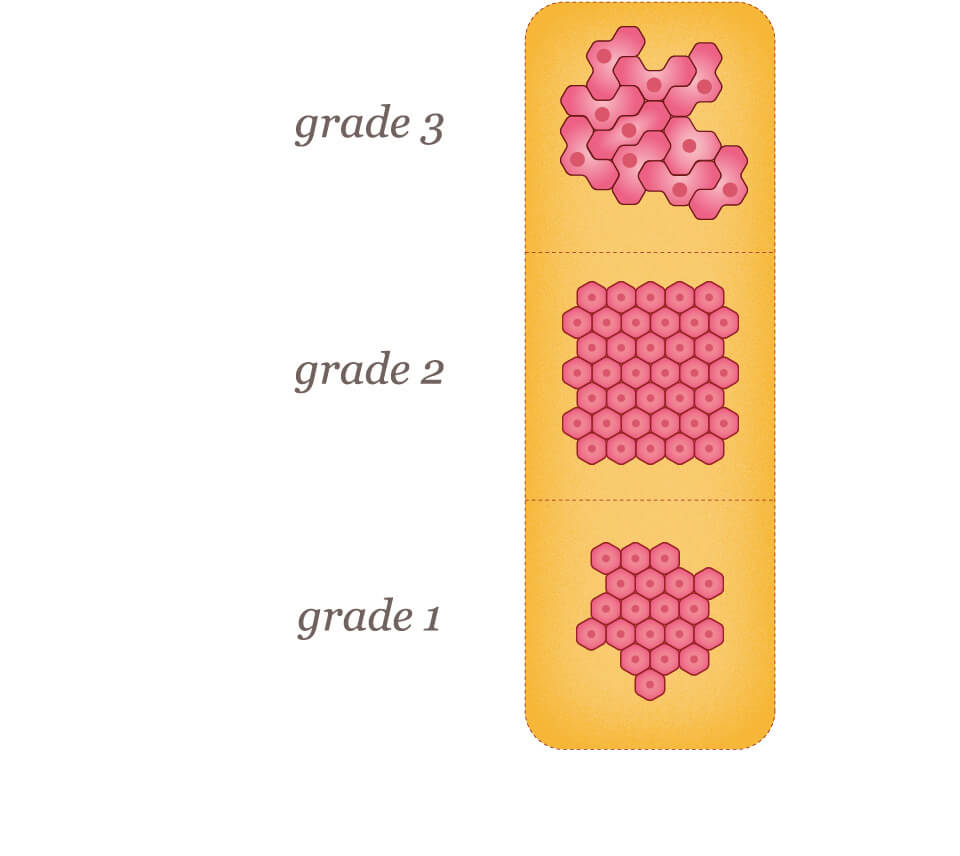
When dealing with breast cancer, tumors are often graded based on a scale of one to three, indicating how aggressive the cancerous cells are:
- Low grade (1) – Well-differentiated, slow-growing cells
- Intermediate grade (2) – Moderately-differentiated, average-growing cells
- High grade (3) – Poorly-differentiated, rapidly-growing cells
Low grade tumors look more like normal tissue under the microscope. High-grade tumors look abnormal and less like normal tissue and tend to be more aggressive.

Breast cancer tumor grades are not to be confused with cancer stages. Tumor grades help to determine the best treatment plan, and in general, a lower grade tumor means a better chance for a full recovery. However, there are individuals who make full recoveries at every stage and with even the highest grades of aggressive tumors.
Sources:
American Cancer Society