


Dense Breast Tissue: What It Means for You


Dense breast tissue is a common and benign finding on a mammogram. Learning that you have dense breasts can leave you wondering what it means and whether you need to do anything differently.
You may have heard that dense breast tissue is associated with a higher risk of breast cancer or that some women benefit from additional screening. It is important to understand what dense breast tissue is, why it matters, and what steps you can take to make informed decisions about your breast health.
Jump to:
What is dense breast tissue?
Why dense breast tissue matters
What affects your breast density
The four dense breast categories
Understanding your mammogram report
Screening options for dense breasts
Next steps
Dense breast FAQs
Advocating for yourself
What is dense breast tissue?
Breasts are made up of different types of tissue: fibroglandular tissue and fatty tissue. Fibroglandular tissue includes the structures within the breast, such as the milk ducts, milk glands (or lobules), and supportive connective tissue. Fatty tissue, also called adipose tissue, is the soft tissue that surrounds these structures and fills in the breast. Breast density describes how much fibroglandular tissue you have compared with fatty tissue on a mammogram.
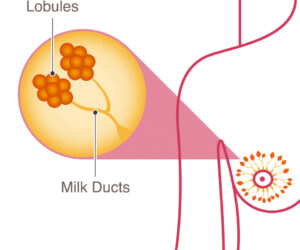
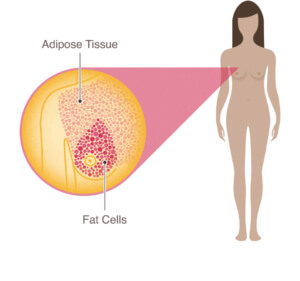
Dense breast tissue is common. Approximately half of women who have a screening mammogram are found to have dense breast tissue. While having dense breasts is normal, it is important to understand what it means.
Why dense breast tissue matters
Dense breast tissue can make breast cancer harder to see on a mammogram
Having dense breast tissue can make breast cancer harder to detect. On a mammogram, both dense tissue and many breast cancers appear white in color. This can make it harder for radiologists to detect small cancers that may be hidden among areas of dense tissue. For this reason, some people with dense tissue are asked to return for additional imaging and a closer look after an initial screening mammogram.
Dense breast tissue raises your risk of breast cancer
In addition to making cancer hard to see on a mammogram, dense breast tissue may also be linked to a slightly higher risk of developing breast cancer for another reason. Researchers are still studying exactly why dense breasts are linked to a higher risk of breast cancer.
One possible explanation is that dense breasts contain more fibroglandular tissue, including epithelial cells (cells that line the ducts and lobules, where most breast cancers begin), which are more susceptible to the genetic changes that can lead to cancer over time. Additionally, denser tissue may be a sign of higher estrogen and/or progesterone levels in the body, which can increase the risk of breast cancer.
What affects your breast density
Breast density can be influenced by several factors, including:
- Genetics: Breast density often runs in families and is largely inherited.
- Age: Dense breast tissue is common in younger women. Breast density typically decreases with age, especially after menopause, as the breasts naturally become fattier and less dense.
- Hormone replacement therapy (HRT): Taking HRT for 6 months or longer, particularly combined estrogen and progesterone therapy, may increase breast density. Women on HRT typically have denser breast tissue than before starting HRT. Discontinuing HRT will usually help reduce breast density.
- Pregnancy: Hormonal changes after pregnancy and having children may also decrease breast density over time.
- Lower body weight: Women with a lower body weight often have denser breasts because they have proportionally less fatty tissue in their breasts. Likewise, significant weight loss may make the breasts appear denser on a mammogram.
Although breast density can change over time, there is no proven way to intentionally change your breast density. Some women’s breast density decreases with age, while others continue to have dense breasts throughout their lives. Both are normal. Breast density is simply one of many factors your healthcare provider considers when assessing your overall breast cancer risk.
How to tell if you have dense breasts
Dense breast tissue is determined by how your breasts appear on imaging, not by how they look or feel, or by breast size. Though some people with dense breasts may notice their breasts feel lumpier because they have more fibroglandular tissue, the only way to know your breast density is through a mammogram.
The four breast density categories
After your mammogram, a radiologist will compare the amount of dense tissue with fatty tissue and assign one of four breast density categories: A, B, C, or D.
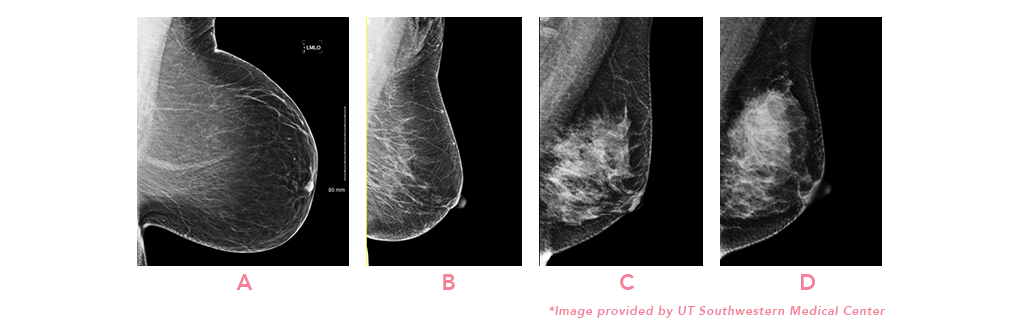
A: Almost entirely fatty — The breasts are made up mostly of fatty tissue. About 10% of women have almost entirely fatty breast tissue.
B: Scattered areas of fibroglandular density — There are some scattered areas of dense tissue, but most of the breast is made up of fatty tissue. About 40% of women have scattered areas of fibroglandular density.
C: Heterogeneously dense — Most of the breast is made up of dense tissue, with some areas of fatty tissue. About 40% of women have heterogeneously dense breast tissue.
D: Extremely dense — Nearly all of the breast is made up of dense tissue. About 10% of women have extremely dense breast tissue.
The first two categories (A and B) are considered not dense, meaning that there is more fatty tissue than fibroglandular tissue. The last two categories (C and D) are considered dense breast tissue, meaning there is a higher proportion of fibroglandular tissue, potentially making breast cancer harder to detect on a mammogram.
After your mammogram
After a radiologist reviews your mammogram, the facility will send a letter notifying you of your breast density. This letter is standard for everyone who receives a mammogram, and it uses standardized language to tell you whether your breasts are dense or not. It may take up to 10 days to receive this letter. If you have not received your letter after 10 days, you can call the facility where you received your mammogram to inquire about it.
What your mammogram letter means
As of September 2024, the U.S. Food and Drug Administration (FDA) requires mammography facilities to tell patients via letter if they have dense breast tissue. The letter you receive from your facility will describe your breast tissue as either “not dense” or “dense.” Most letters will not specify which level of density (A, B, C, or D) you have, but you can call the facility or your healthcare provider to ask for that information, if desired.
If you receive a letter stating that you have dense breast tissue, it is not a reason to be afraid. Instead, think of it as helpful information to guide your care. Begin by talking with your healthcare provider about your personal risk factors and whether additional screening, along with your routine mammograms, may be right for you.
Understanding your mammogram report
In addition to details about any findings, your mammogram report will also include a BI-RADS (Breast Imaging Reporting and Data System) assessment category. This is a standardized system that helps radiologists describe what was seen on your imaging and guides recommendations for follow-up care, if needed.
BI-RADS categories range from 0 to 6:
- BI-RADS 0: More imaging is needed before a final assessment can be made
- BI-RADS 1: Negative (no abnormal findings)
- BI-RADS 2: Benign (non-cancerous) finding
- BI-RADS 3: Probably benign. This means the finding has a 98% or greater chance of being non-cancerous. Instead of a biopsy, the radiologist usually recommends repeat imaging in about six months to confirm that the area remains stable
- BI-RADS 4: Suspicious abnormality. A biopsy is usually recommended because there is a possibility of cancer
- BI-RADS 5: Highly suggestive of cancer. A biopsy is strongly recommended
- BI-RADS 6: A biopsy has already confirmed cancer
Dense breast tissue itself is not assigned a BI-RADS category. Instead, breast density is reported separately using one of the four breast density categories discussed above. However, women with dense breasts may sometimes be asked to return for additional imaging if an area is difficult to evaluate because dense tissue can make mammograms harder to interpret.
Learn more about BI-RADS categories.
Screening options for dense breasts
A mammogram is still the most important screening test for breast cancer, even if you have dense breasts.
The American Society of Breast Surgeons recommends yearly screening mammograms starting at age 40 for women at average risk of breast cancer. If available, 3D mammography (also called digital breast tomosynthesis) is preferred because it can find more breast cancers and lower the chance of being called back for more testing.
Having dense breasts alone does not automatically mean you need additional screening. Instead, the decision is based on your overall breast cancer risk, including your breast density, age, family history, personal medical history, genetic testing results, and other risk factors.
Your healthcare provider will use all of this information to determine whether supplemental screening is appropriate and, if so, which screening test may be the best option for you.
Depending on your individual risk, your healthcare provider may recommend one of the following supplemental screening tests.
Supplemental screening test | Who might benefit | What to know |
Women at high risk for breast cancer | The most sensitive screening test currently available for detecting breast cancer. Requires an IV contrast dye and is typically recommended for those at high risk. | |
Abbreviated breast MRI (FAST MRI) | Women at intermediate (above-average) risk | A shorter version of a breast MRI that offers similar cancer detection while reducing the time spent in the scanner. Usually self-pay. |
Breast ultrasound (or whole breast ultrasound) | Women with dense breasts, especially if MRI is not an option | May detect cancers not visible on a mammogram, but it also increases the chance of false-positive findings and additional testing. |
Contrast-enhanced mammography (CEM) | Women who cannot undergo breast MRI | A newer type of mammogram that uses an IV contrast dye to help highlight areas that may need a closer look. |
No screening test is perfect. While supplemental screening can detect cancers that may not be seen on a mammogram, it can also increase the chance of false-positive results, additional imaging, or biopsies that ultimately show no cancer.
Insurance coverage for supplemental screening varies by the type of test, your individual level of risk, and your insurance plan. Abbreviated breast MRI (FAST MRI) is often offered as a self-pay exam, while insurance coverage for a full breast MRI, whole breast ultrasound, or contrast-enhanced mammography (CEM) depends on your insurance plan and whether you meet your plan’s medical necessity criteria.
If supplemental screening is recommended, ask your healthcare provider and your insurance company about your expected out-of-pocket costs before scheduling your exam. The best screening plan is one that is tailored to your individual breast cancer risk, personal preferences, insurance coverage, and shared decision-making with your healthcare provider.
Next steps
If you’ve had a mammogram, look at your report to see whether your breasts are classified as dense or not dense. If your report says you have dense breasts, don’t panic. Dense breast tissue is common, but it is worth talking with your healthcare provider about what it means for you.
Breast density is only one part of your overall breast cancer risk. Ask your healthcare provider to perform a formal breast cancer risk assessment using a validated risk model, such as the Tyrer-Cuzick model. This helps estimate your lifetime risk of breast cancer and, together with your breast density and other risk factors, can help determine whether supplemental screening is appropriate and which screening test may be the best option for you.
If you have dense breasts, consider asking your healthcare provider these questions:
- Do I have heterogeneously dense (C) or extremely dense (D) breasts?
- What is my overall lifetime risk of breast cancer?
- Have I had a formal breast cancer risk assessment, such as the Tyrer-Cuzick model?
- Do I meet the criteria for supplemental screening? If so, which screening test is right for me?
- Will my insurance cover supplemental screening?
- Should my supplemental screening be scheduled about six months after my mammogram to provide screening throughout the year?
Dense Breasts Q&A Guide
Walk into your appointment prepared. Our free Dense Breasts Q&A Guide, written by breast health and screening experts, helps you understand your density level and the questions to ask.
Get the Free GuideDense breasts frequently asked questions
What does it mean to have dense breast tissue?
Having dense breast tissue means your breasts have more fibroglandular (milk-producing and supportive) tissue than fatty tissue. A radiologist determines breast density on a mammogram. Although dense breast tissue is a common, normal finding, it can slightly increase your risk of one day being diagnosed with breast cancer and may require additional screening, depending on your other personal risk factors.
Is dense breast tissue something to worry about?
Dense breast tissue is common and is not a disease or a diagnosis of breast cancer. The FDA requires mammography facilities to notify you if you have dense breasts so you can discuss your breast density, overall breast cancer risk, and whether additional screening may be appropriate with your healthcare provider.
Can dense breasts go away?
Breast density can change over time. As you age, especially after menopause, your breasts often become fattier and less dense, although some women continue to have dense breasts throughout their lives. Both are normal.
How do I know if I have dense breasts?
The only way to know if you have dense breasts is through a mammogram. A radiologist determines your breast density and includes it in your mammogram report.
Should I still have a mammogram if I have dense breasts?
Yes. A mammogram remains the most important screening test for breast cancer, even if you have dense breasts. While dense breast tissue can make some cancers harder to see, mammograms still detect many breast cancers early. Depending on your overall breast cancer risk, your healthcare provider may also recommend supplemental screening, such as a breast MRI, in addition to, not instead of, a mammogram.
What screening do I need if I have dense breasts?
A mammogram remains the foundation of breast cancer screening. Depending on your overall breast cancer risk, your healthcare provider may also recommend supplemental screening, such as breast MRI, abbreviated breast MRI (FAST MRI), whole breast ultrasound, contrast-enhanced mammography (CEM), or molecular breast imaging (MBI), when appropriate.
Does dense breast tissue mean I have breast cancer?
No. Dense breast tissue is not breast cancer and does not mean you have cancer. However, because both dense breast tissue and many breast cancers appear white on a mammogram, dense breasts can make some cancers more difficult to detect, especially in the early stages when it is small.
Should everyone with dense breasts have additional screening?
Having dense breasts alone does not automatically mean you need supplemental screening, such as a breast MRI, particularly if your breast density score is C or D. The decision is based on your overall breast cancer risk, including factors such as your age, family history, genetic testing results, personal medical history, and breast density. A formal breast cancer risk assessment, using a validated model such as the Tyrer-Cuzick model, can help determine whether supplemental screening may be beneficial and, if so, which screening test is right for you.
You are your own best advocate
Understanding your breast density is one step toward taking charge of your breast health. While dense breast tissue is common and is not a disease, knowing your breast density and your overall breast cancer risk can help you and your healthcare provider make informed decisions about screening.
Here are a few ways you can advocate for yourself:
- Know your risk. In addition to dense breast tissue, there are other risk factors for breast cancer. Review your risks as well as your family medical history and discuss with your doctor. Taking a risk assessment, such as the Tyrer-Cuzick, may also be helpful in determining your lifetime risk of breast cancer and the screening recommendations that are best for you.
- Know your breast density. If you have had a mammogram, review your mammogram report to see whether your breasts are classified as dense or not dense.
- Know your family history for cancers. Stay on top of knowing who in your family for 3 generations have had any type of cancer. Some cancers, such as ovarian cancer in women or prostate cancer in men, are linked to an increased risk of breast cancer.
- Start the conversation. If you have dense breasts, ask your healthcare provider whether supplemental screening, such as a breast MRI or whole breast ultrasound, may be beneficial based on your overall risk.
- Ask for a referral if needed. If you still have questions about your risk, breast density, or your need for supplemental screening after talking with your healthcare provider, ask to be referred to a breast specialist, such as a breast surgeon or breast care provider, for a more individualized risk assessment and screening plan.
- Stay up to date with screening. Follow the screening plan recommended by your healthcare provider and let them know if your personal or family history changes over time.
Understanding your personal risk, asking questions, and staying informed are some of the best ways to advocate for your breast health and early detection.
Early Detection & Support
Early detection is one of the most powerful tools we have. Explore NBCF’s free breast health resources and look for a free screening near you.
Breast Health Resources Look for a Free ScreeningSources
American Cancer Society
National Institutes of Health